Human-approved automation
Provides permitted operations that humans and AI can request against the IOM. Each invocation is checked against current scope, parameters, permissions, conditions, and required approvals.
Give AI an operating foundation—not just infrastructure access.
Your infrastructure works as one system. Its operating knowledge is spread across devices, tools, records, code, and people. AuthoriOM brings that context into a maintained, customer-owned Infrastructure Operating Model (IOM), equipped with human-approved automation and workflow orchestration within defined authority.
Understand impact before change. Resolve drift through approved action. Verify what actually happened.
 One living model
Ground AI in your infrastructure model—with the context to understand, the authority to act, and verification to confirm the result.
A customer-owned operating foundation.
AI action within defined authority.
Detect differences. Reconcile through approved action. Verify alignment.
Carry verified operating knowledge into the next change.
Customer name withheld at their request. This is an engagement-specific outcome; scope and timelines vary.
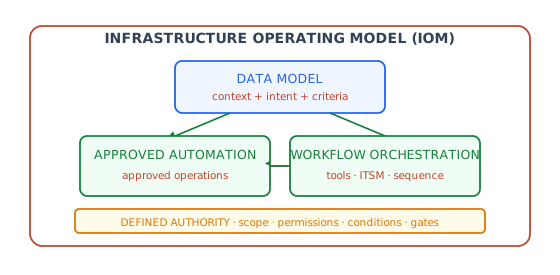
The Data Model maintains understanding. Human-approved automation provides permitted actions. Workflow orchestration coordinates the work. Defined authority governs their use; it is not a separate component.
Provides permitted operations that humans and AI can request against the IOM. Each invocation is checked against current scope, parameters, permissions, conditions, and required approvals.
Coordinates those operations across existing tools, including sequencing, dependencies, exceptions, verification, and recovery steps.
Humans and AI interact with the IOM. Authorized integrations retain infrastructure access and enforce permissions and required approvals on enabled execution paths. Observations and evidence return to the model.
The next change, investigation, and handover start with knowledge your team retains. Keep the evidence, its source, and what still needs checking.
Review maintained dependencies, accountable owners, and approved requirements before planning the next action.
Connect recorded changes and verification evidence to the affected service. Investigate gaps rather than reconstructing the whole picture.
Keep operating context in a customer-owned model so the next team can review what is known, what was approved, and what still needs validation.
Which two or three outcomes matter most? Start with documentation, drift, security and audit evidence, model-driven observability, recovery planning, or retained knowledge. Validate the relevant capabilities against your environment.
Before a network change, trace the applications and business services that depend on it.
Explore connected change ↗Give AIOps proposals infrastructure context and evaluate connected action against customer-declared rules.
Explore AIOps governance ↗Compare what telemetry shows with what the model says should be true. Use the same dependencies and intended configurations to plan migrations and verify the destination.
Explore migration and verification ↗Plan recovery from maintained dependencies, ownership, and intended configurations. Verify restored services against agreed requirements.
Explore continuity ↗Choose a focused scope and two or three outcomes worth proving. Agree the baseline, acceptance criteria, prerequisites, accountable owner, and decision the evidence should support before work starts. For a product demonstration first, book a demo ↗.
Use the questionnaire to identify operating gaps, or bring a recent change or incident. Prioritize the outcomes that would change the team’s day; the score is a discussion aid, not a readiness certification.
Start the assessment ↗In a working session, agree scope, approved sources, baseline, acceptance criteria, prerequisites, owner, and the next decision. Use a focused technical demonstration only where a question remains. No systems connect during this session.
Scope your First Working IOM ↗Build a bounded read-only model and evaluate the selected outcomes against agreed evidence. Target 30 days from the agreed start once access and prerequisites are ready; this is a planning frame, not a guarantee. Review the result and gaps before separately authorizing any execution path.
Explore the First Working IOM ↗You own the model, data, and operating knowledge in every package. Choose the division of work that fits your team.
Your team builds and operates the IOM with the AuthoriOM software.
Explore the platform ↗Share the operating work with AuthoriOM against a defined scope and block of hours.
Explore co-managed ↗AuthoriOM operates the agreed IOM scope within the rules you declare.
Explore fully managed ↗Start with one environment. Define the scope, deployment needs, and operating responsibilities together.
Retain delivery knowledge. Build repeatable services.
Explore partnering ↗Understand the operating model, connected scope, and how to evaluate the platform.
Read the evaluation brief ↗GET STARTEDChoose the outcomes, evidence, and read-only scope that will support your next decision.
Explore the first 30 days ↗EXAMINE EVIDENCEReview customer outcomes and distinguish delivered evidence from illustrative examples.
Explore customer proof ↗Bring the two or three operating outcomes that matter most. See the relevant capabilities, scope a First Working IOM, and expand authority only after reviewing evidence, responsibilities, and required approvals.
Follow the journey from scattered infrastructure context to a maintained model, governed action and verified outcomes.
Play the whiteboard